

 INSTALLAZIONE
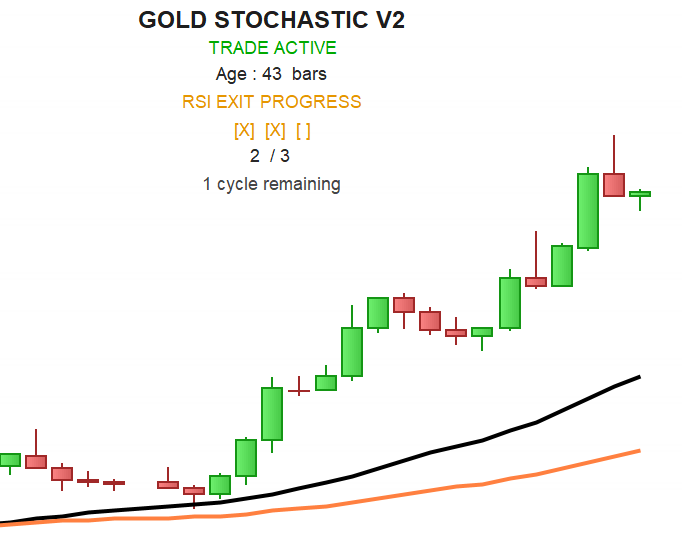
Core Strategy Pillars
1️⃣ Momentum Exhaustion Confirmation
The strategy monitors the stochastic oscillator for conditions where price momentum reaches an extreme.
Long setups are generated when:
- the stochastic reaches the oversold region;
- %K and %D confirm a bullish momentum rotation;
- the required confirmation sequence is completed.
This allows the strategy to identify potential recovery moves following structured pullbacks or exhaustion events.
2️⃣ Adaptive Volatility Management
Gold volatility can change considerably between market regimes.
Version 2 measures current Average True Range relative to its recent baseline and classifies volatility into:
- normal;
- high;
- extreme.
The stop-loss multiplier automatically adjusts according to the detected volatility regime, allowing the strategy to respond more appropriately when the market becomes unusually active.
3️⃣ Risk-Normalised Position Sizing
Position size is calculated using:
- current strategy capital;
- the selected risk allocation;
- the actual volatility-adjusted stop distance.
As the stop distance increases, the position size decreases. As the stop distance contracts, the position size may increase, subject to the configured maximum bet per point.
This provides more consistent risk exposure across changing volatility conditions than the fixed stop-distance assumption used in Version 1.
4️⃣ Post-Loss Trade Cooldown
Persistent directional markets can produce repeated reversal signals before a genuine recovery begins.
Following a losing trade, Version 2 temporarily prevents another long entry for a configurable number of completed 1-hour bars.
The default setting is:
17 barsThis cooling-off period is designed to reduce repeated entries during sustained adverse market conditions while preserving the strategy’s original entry methodology.
✅ What It Delivers
- Fully automated long trade entries
- Oversold and momentum-rotation detection
- Dynamic ATR volatility classification
- Volatility-adjusted stop-loss placement
- Risk-normalised position sizing
- Post-loss trade cooldown
- RSI-based profit-taking logic
- Optional moving-average crossover exit
- Friday trading restrictions and position closure
- Designed specifically for XAUUSD on the 1-hour timeframe
- Fully systematic execution with no discretionary intervention required
🎯 Ideal For
- Intraday and swing-oriented gold traders
- Momentum and structured-pullback traders
- Traders seeking rule-based execution
- ProRealTime users looking for automated XAUUSD exposure
- Traders who prefer systematic risk controls over discretionary decision-making
⚙️ Strategy Philosophy
Gold is a momentum-driven instrument capable of producing both persistent trends and sharp exhaustion moves.
TPT Gold Stochastic V2 is designed to:
- identify potential exhaustion at momentum extremes;
- capture structured recoveries following pullbacks;
- participate in sustained upside moves;
- adjust stop placement as volatility changes;
- maintain more consistent capital risk;
- reduce repeated entries following unsuccessful trades;
- deliver repeatable and testable execution.
The strategy does not attempt to predict every market turn. It waits for defined technical conditions and applies the same rules consistently.
Capital and Risk Configuration
Suggested starting capital:
£2,000 or greaterThe strategy adjusts position size according to available strategy capital, configured risk allocation and the calculated stop distance.
Actual trading results may differ from theoretical risk calculations because of factors such as spread, slippage, gaps, minimum position sizes and broker execution.
ProRealTime Settings
Please ensure that ProRealTime is set for XAUUSD Custom Trading Hours (UTC-04:00) America/New York.
Configurable Variables
STRATEGYINITIALCAPITAL
Sets the strategy’s starting capital.
The strategy subsequently adjusts available capital using realised strategy profit and loss:
Available capital =
STRATEGYINITIALCAPITAL + STRATEGYPROFIT
The value should correspond with the capital allocated to the strategy.
RISKCAPITALPERBET
Defines the proportion of available strategy capital allocated to each trade.
Suggested starting value:
0.045This represents 4.5% within the strategy’s sizing calculation.
Unlike Version 1, Version 2 calculates position size using the actual volatility-adjusted stop distance. This creates a closer relationship between the selected risk allocation and the calculated trade exposure.
The realised loss may still differ because of spread, slippage, price gaps, execution conditions and broker position-size constraints.
MAXBETPERPOINT
Sets the maximum permitted bet per point.
Position size can increase or decrease as:
- strategy capital changes;
- volatility changes;
- the calculated stop distance changes.
MAXBETPERPOINT prevents the automated sizing calculation from exceeding the user-defined exposure limit.
Cumulative orders are disabled, so the strategy can hold only one position at a time.
TRADESTARTTIME
Sets the earliest permitted time for opening a new trade.
TRADEENDTIME
Sets the latest permitted time for opening a new trade.
BLOCKFRIAFTERTIME
Prevents new trades from opening after the configured time on Friday.
Open positions are separately instructed to close during the defined Friday exit window.
USEMACROSSEXIT
Enables or disables the optional moving-average crossover exit.
When enabled, an open long trade may close if the fast moving average crosses below the slow moving average.
1 = enabled
0 = disabled
MAFAST
Sets the fast moving-average period used by the optional moving-average exit.
MASLOW
Sets the slow moving-average period used by the optional moving-average exit.
LOSSCOOLDOWNBARS
Sets the number of completed 1-hour bars during which new long entries are blocked following a losing trade.
Recommended V2 setting:
17This feature is designed to reduce repeated entries during persistent adverse price movement.
Internal V2 Volatility Controls
Version 2 no longer uses the external ATRMULT variable.
Stop placement is now controlled internally through three volatility regimes:
Normal volatility
High volatility
Extreme volatility
The strategy compares current ATR with its recent ATR baseline and selects the appropriate stop multiplier automatically.
This replaces the single fixed ATR multiplier used by Version 1.
Friday Position Management
The strategy blocks new Friday entries after the configured cutoff and closes any remaining open position during the Friday exit window.
Default Friday closure logic begins after:
15:00:00The applicable platform and chart timezone should be confirmed before deployment.
🧠 Built for Discipline
No subjective chart drawing.
No emotional overrides.
No discretionary signal selection.
Just:
Exhaustion
+
Confirmation
+
Adaptive Risk
+
Controlled Re-entry
📊 Version 2 Development Objective
Recent market conditions demonstrated a significant increase in volatility together with longer-lasting directional phases than those observed during earlier testing.
Version 1 remained structurally biased toward capturing long-side pullbacks and exhaustion recoveries, but repeated signals during persistent downward phases could produce clusters of unsuccessful trades.
Version 2 was developed to address this through:
- adaptive volatility-based stop placement;
- position sizing based on the actual stop distance;
- reduced exposure as volatility expands;
- a defined cooling-off period following losing trades.
These changes strengthen the strategy’s behaviour without replacing its established stochastic entry methodology.
📈 Representative Historical Back Test
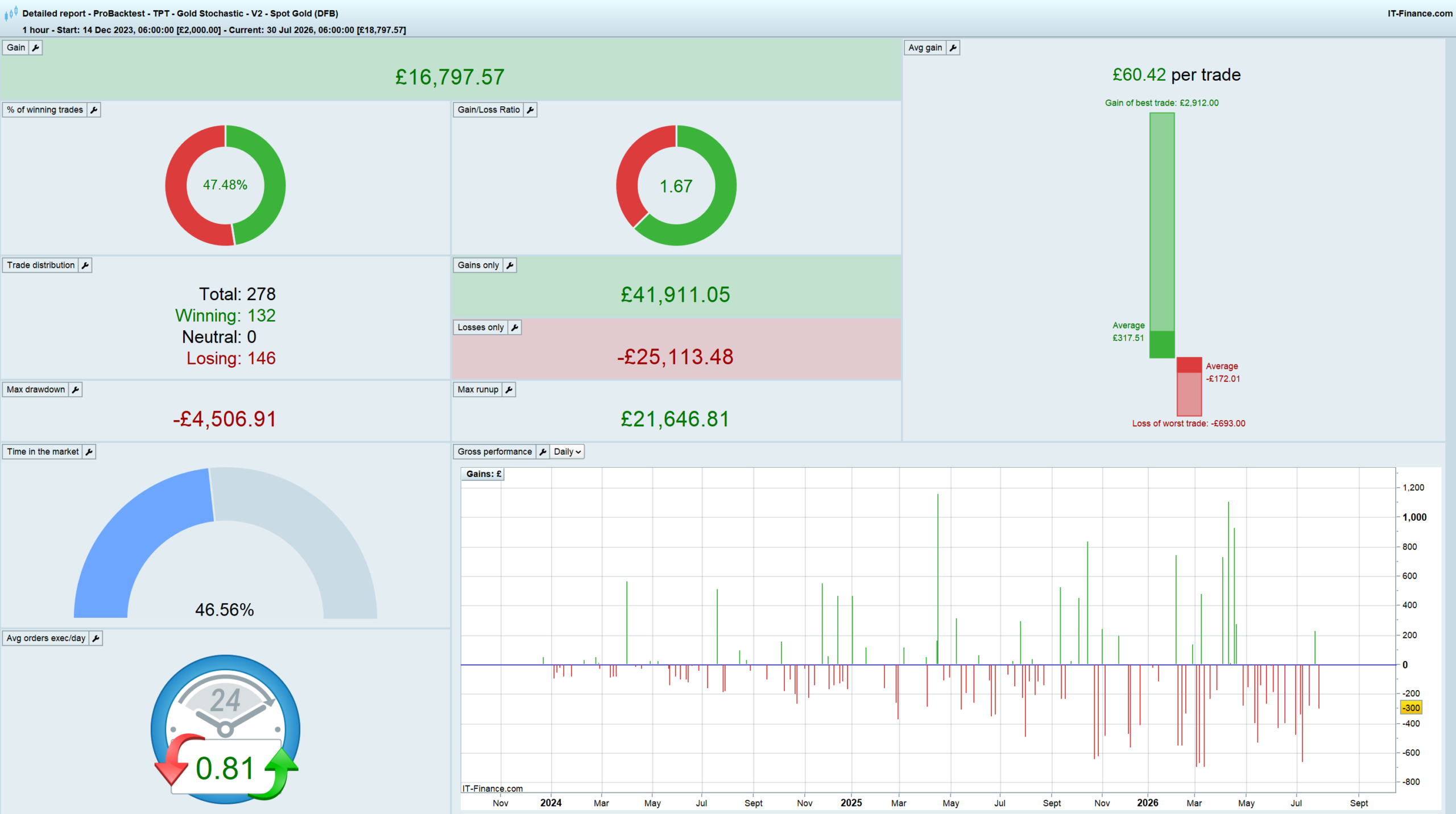
TPT-Gold-Stochastic-V2-backtest-dashboard
Setup
Starting capital = £2000
Spread = 1.5 pips
Timeframe = 1 Hour
Asset = XAUUSD
Performance Statistics & Trade Distribution
The back test detailed performance report highlights the robustness of the system’s structure:
-
Win Rate: 47.48%
-
Gain/Loss Ratio: 1.67
-
Average Gain per Trade: £317.51
-
Maximum Run-Up: £21,646.81
-
Maximum Drawdown: £4,506.91
-
Total Trades: 278
-
Time in Market: 46.56%
The strategy maintains a favourable reward-to-risk profile, with average winners significantly larger than average losers.
Importantly, the system does not rely on extremely high win rates — it focuses on asymmetric trade structure.
This is a hallmark of sustainable trading systems.
TPT-Gold-Stochastic-V2-backtest-performance-calendar
Month-by-Month Consistency
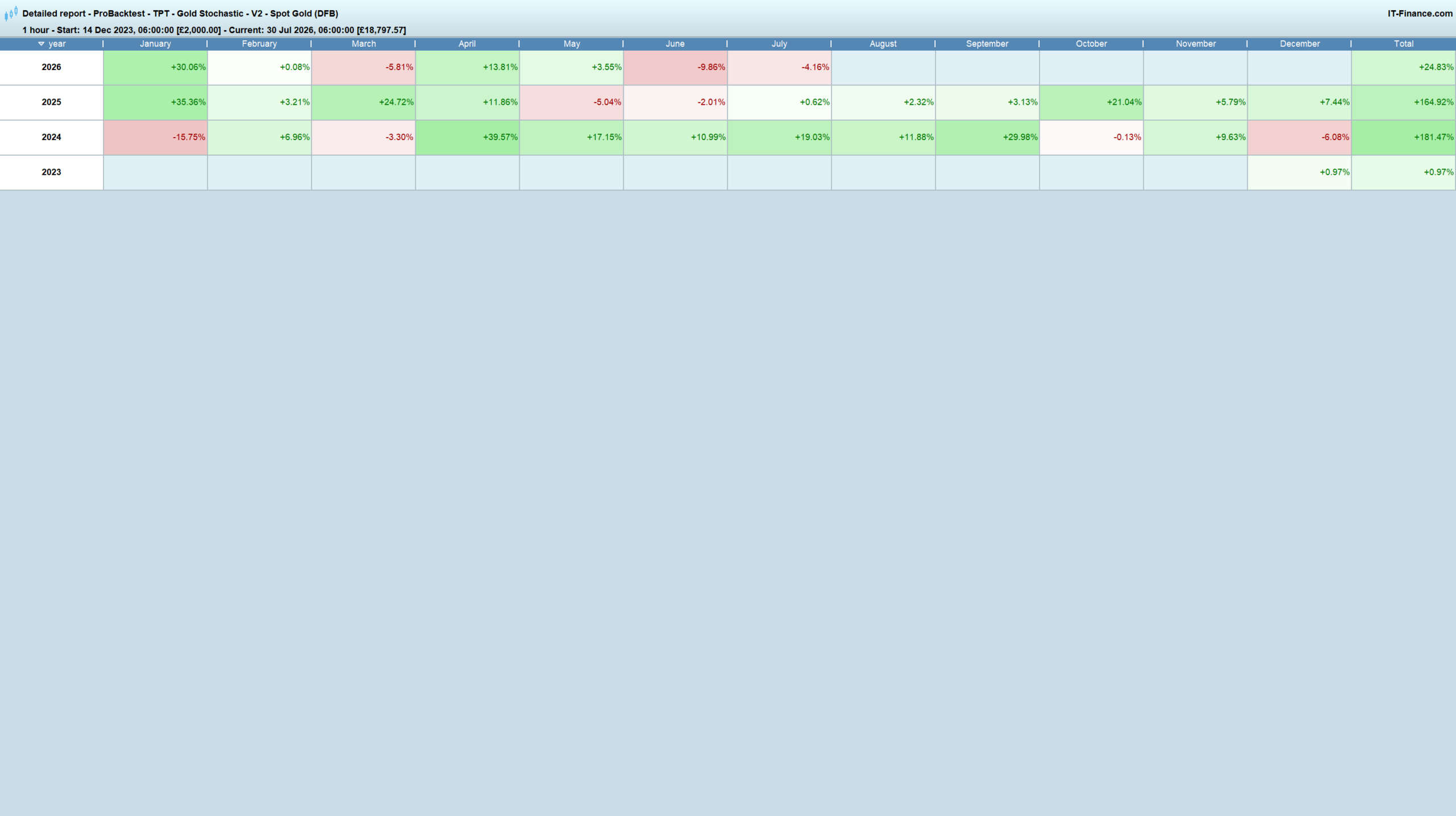
The back test calendar view demonstrates the strategy’s ability to perform across varying market conditions.
2024 highlights include:
-
+39.57% in April
-
+17.15% in May
-
+29.98% in September
-
Strong 2024 performance
2025 highlights include:
-
+35.36% in January
-
+24.72% in March
-
+21.04% in October
-
Strong 2025 performance
2026 highlights include:
-
+30.06% in January
-
+13.81% in April
While some months show retracements, performance remains structured with rapid recovery phases.
The system benefits from gold’s cyclical momentum and volatility expansions.
🎯 Why Version 2 Was Developed
The market behaviour observed during 2026 exposed a weakness common to many pullback systems—repeated entries during prolonged directional phases.
Version 2 was specifically engineered to improve behaviour under these conditions.
A focused back test of 2026 to date (30/07/2026) provided a compelling case for the V2 update.
| Metric | V1 | V2 |
|---|---|---|
| Net Profit | -£602.71 | +£763.19 |
| Maximum Drawdown | -£4,232 | -£1,555 |
| Gain/Loss Ratio | 0.91 | 1.26 |
Based on the back test results, V2 materially improved the strategy’s behaviour during the difficult 2026 period.
Gold Stochastic V2
TPT Gold Stochastic V2 represents a major risk-management and behavioural update to the original strategy.
It preserves the established stochastic exhaustion methodology while adding:
- adaptive volatility management;
- risk-normalised position sizing;
- improved control of repeated post-loss entries.
The objective is not to eliminate losing trades or predict every change in market direction. It is to provide a more resilient and disciplined execution framework as Gold’s volatility and market structure evolve.
Version 2 Improvements
✓ Adaptive ATR stop-loss sizing
✓ Volatility-aware position sizing
✓ Automatic volatility regime detection
✓ Intelligent post-loss cooldown
✓ Improved resilience during prolonged directional markets
✓ Cleaner and simplified configuration
Important Notice
Backtested and historical performance is not a guarantee of future results.
Automated trading involves risk, and losses may exceed modelled values due to slippage, spread changes, market gaps, execution delays or broker-specific trading conditions. Users should validate all settings, timezone assumptions, minimum trade sizes and risk limits within their own ProRealTime and broker environment before enabling live execution.
Recensioni
Ancora non ci sono recensioni.